Showing posts with label Knowledge Management. Show all posts

Monday, May 26, 2014

Nature of Knowledge Management

Understanding the Difference among Knowledge, Data and Information

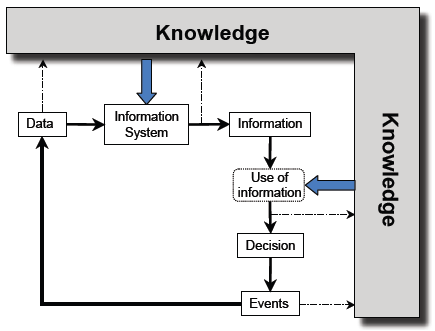
Data represents raw numbers and assertions. It comprises facts, observations or perceptions. Data is just bits, many zeroes and ones.

Example: Bits representing score on examination including score in test 1 and score in test 2.

Information is data with context and relevance. While data are nothing but useless garbage bits and uninterpretable zeroes and ones, information can be used to obtain a more meaningful indication of trends and patterns.

Example: In a test, the result of the frequency of errors interprets if the item is too difficult or too easy to answer.

Knowledge is information with decision-making and action-directed utility and purpose. Knowledge is the highest level in the hierarchy, with information in them middle, and data ot be at the lowest level. This is the richest, deepest and most valuable of the three.

Example: The information in the frequency error and score of test items shows the validity of each item in the test if there's a need to be retained or to be revised.

Knowledge is the information that helps to produce information from data or produce valuable information from less valuable information.


Types of Knowledge

Epistemology is the branch of philosophy that studies the nature of knowledge, its presuppositions and foundations, and its extent and validity (American Heritage Dictionary of the English Language, Fourth Edition.

There are many classifications and characterizations of types of knowledge, e.g. individual, social, causal, conditional, relational, pragmatic encoded, encoded and procedural. It is very important to know what knowledge is before we can manage it effectively.

Subjective View of Knowledge

In this kind of view, reality is entirely dependent on human perception and is socially constructed through interaction and individuals.  
·         Knowledge has no existence independently of social practices and human experience
·         Knowledge is not an independent object
·         Knowledge has no single location
·         Knowledge is viewed as an on-going accomplishment

Objective View of Knowledge

In objective view of knowledge, reality is independent of human perceptions and can be structured in terms of priori categories and concepts. 
·         Knowledge can be located
·         Knowledge is something that can be stored, transferred, and manipulated
·         Knowledge enables access and utilization of information
·         Knowledge is a strategic capability that can potentially be applied to seek a competitive
      
advantage 

Procedural vs. Declarative Knowledge

Declarative Knowledge focuses on beliefs about relationships among variables.

Example: “All other things being equal, greater price charge for a product would cause some reduction in its number of sales.”

It can be stated in the form of logical propositions, expected correlations, or formulas relating concepts represented as logical symbols and/or mathematical variables. This is often characterized in KM circles as “know-what.”

Procedural Knowledge focuses on beliefs relating procedures or processes: sequences or steps or actions to desired or undesired outcomes.  

Example: The procedure that should be followed in a government organization in deciding on whom to award the contract for a particular area (information system development).
It is often characterized in KM circles as “know-how.”

Tacit vs. Explicit

Tacit Knowledge includes insights, intuitions, and hunches that are not verbalized or documented. This is usually difficult to express and formalized. Therefore, it is difficult to share. It is a phenomenon wherein the employee can’t really tell how to do something.  

Explicit Knowledge refers to knowledge that has been expressed into words or numbers. It can be shared formally and systematically in the form of data, specifications, manuals, drawings, audio or video tapes, computer programs, patents, etc.

Can we convert explicit knowledge to tacit knowledge?

We often convert explicit knowledge to tacit knowledge. It usually happens when an individual reads a book and learns some insights from it, but not by rote memorization.  

Can we convert tacit knowledge to explicit knowledge?

We can sometimes convert tacit knowledge to explicit knowledge. It happens when an individual, who has a lot of tacit knowledge, writes a book formalizing that knowledge. More often, it is like difficult conversion that requires hard efforts.

General vs. Specific Knowledge

General Knowledge is possessed by a large number of individuals and can be transferred easily across individuals.

Example: Headache is one symptom of brain hemorrhage.

Specific Knowledge (idiosyncratic knowledge) is possessed by a very limited number of individuals, and is expensive to transfer.

Example: How to operate on a patient suffering a stroke.

Technically vs. Contextually Specific Knowledge

Technically Specific Knowledge is a deep knowledge about a specific area. It includes tools and techniques for solving problems. It is often acquired through formal training and experience in the field.

Examples:          
  • The scientific knowledge of a marine biologist
  • The knowledge about computer hardware by an engineer
Contextually Specific Knowledge refers to the knowledge of particular circumstances of time and place in which work is to be performed. It can not be acquired through formal training.

Examples:               
  • The detailed knowledge that design engineers possessed about the idiosyncrasies of the particular design group they are working 
  • Basketball forward detailed knowledge about the team’s center
Reference:
Becerra-Fernandez, I. and Sabherwal, R. (2010). Knowledge Management: Systems and Processes. New York: ME Sharpe, Inc. 

Thursday, May 22, 2014

Introduction to Knowledge Management

Image Source: www.kassoftindia.com

Why is there a need for Knowledge Management?

According to Peter Drucker, knowledge has become the key source for the nation’s military and economic strength, so that there is a need for the systematic work on quality of knowledge and productivity of knowledge. The survival of every organization in the knowledge society highly depends on those two factors.   

What is Knowledge Management?

Knowledge Management (KM) is the process of capturing, developing, sharing and effectively using organizational knowledge (Davenport, 1994). It is about managing the knowledge life cycle, which includes the processes of knowledge creation, knowledge transfer and knowledge use. It is also related to the concept of intellectual capital.

Human vs. Structural Capital

Human Capital – t his is the body of knowledge that an organization possesses. This is the knowledge in the minds of the software developers, researchers, academic collaborators, business managers, and even the knowledge of the teachers and students in educational institution.

Structural Capital – this is everything that remains after the employees go home. It can be in the form of copyrights, customer files, business process software, databases, software manuals, trademarks and organizational structures. All these refer to the organizational capability.

What are the forces driving the Knowledge Management?

Now that we are in the Digital Age, the need to manage the intellectual capital becomes the major priority of all organizations and this is because of the following driving forces:

·         Increasing Domain Complexity – there is an apparent increase in complexity of the underlying knowledge. Intricacy of internal and external processes, increased in competition and continuous advancement in technology lead to increasing domain complexity. Curriculum development now typically requires not only brainstorming sessions by freethinking content designers but also partnerships by inter-organizational teams representing many various functional subunits.
·         Accelerating Market Volatility – the pace of change within each market has increased rapidly in the past decade. Market and environmental influences can result in overnight changes in an organization.
·         Intensified Speed of Responsiveness – because of technology, the decision-making landscape has changed and the time required to take an action for a particular issue is decreasing.
·        Diminishing Individual Experience – high employee turn-over rates have resulted in individuals with decision-making authority having less tenure within their organizations than ever before. This factor often tends to damage the mission-critical decision making, because of immature intuition, pressure for faster responsiveness and higher risk of wrong or unclear decision responses.

Is Knowledge Management for everybody?

Of course! KM is important for all kinds of organization. With KM, we can come up of better and faster decisions in an environment characterized by a high domain complexity and market volatility despite decision maker’s lack of experience.

Knowledge Management Systems (KMS)

The breakthroughs in Information and Communications Technology facilitate sharing as well as accelerated growth in knowledge. Nowadays, knowledge is accumulating at an ever increasing rate. It is estimated that knowledge is currently doubling every 18 months and, of course, the pace is increasing... Technology facilitates the speed at which knowledge and ideas proliferate (Bradley, 1996). Knowledge Management System is the synergy between the latest technologies and social/structural mechanisms. With KMS, the employees can have an access to all the organization’s extensive documented base of facts, sources of information and immediate solutions.

An example of Knowledge Management System is the company’s Intranet portal and database, wherein the members can also update and even share their findings that can be a valuable contribution to the intellectual capital of the organization. Web-based conferencing is also a great instance of KMS, bridging knowledge sharing beyond time and geographical limitations.

What is an effective Knowledge Management?

You might be surprised that an effective KM is 80% focus on organizational culture and human factors and 20% on technology.  It is not always technology that will bring positive results in our organization when it comes to Knowledge Management. Remember that to effectively apply Artificial Intelligence, we must understand Human Intelligence and Human Computer Interaction.  

Reference:
Becerra-Fernandez, I. and Sabherwal, R. (2010). Knowledge Management: Systems and Processes. New York: ME Sharpe, Inc.