Showing posts with label ICT. Show all posts

Saturday, May 2, 2015

Winning Big Time in Technolympics 2015

Last February 10-11, 2015, our division held the TECHNOLYMPICS COMPETITION 2015 with the theme “Optimizing Creativity.” Sixteen public high schools participated in different skills competitions. The delegation of our school, Gen. Tiburcio de Leon National High School was a strong team with determined trainers and student representatives.

The following are the trainers who were able to bag places in their assigned contest:

ICT
Web Designing
Marlon L. Lalaguna
Third Place
Tarpaulin Designing
Jeffry S. Reovoca
Second Place
Home Economics
Experimental Fish Dish
Marivic C. Francisco
Third Place
Hair and Make-Up
Jenny S. LoseƱada
First Place
Children’s Wear Construction
Maricel N. Bautista
Third Place
Agriculture
Landscaping
Leonardo A. Parel
Second Place
               
We were so delighted that all our efforts and sacrifices paid off. An addition to this year’s Technolympics was the recognition of an over-all champion, which is based on the scores accumulated for every place that is won by the school. Fortunately, our school also won as the OVER-ALL CHAMPION. Mrs. Rona M. Reyes, our head teacher-in-charge, was so happy about the success of our department and said that the collaborative efforts and hard work of all the trainers and student representatives, who devoted most of their time in training, were the important aspects of this milestone.

Hopefully, we will perform the same or even more in the Technolympics next year.  To God be the glory.

Photo Credits: Rona Reyes


Sunday, February 8, 2015

Technolympics 2015

Next week, our division will be holding the TECHNOLYMPICS 2015 with the theme "Optimizing Creativity." The following skill competitions are included as contest packages:
  • Experimental Fish Dish
  • Experimental Cookery
  • Web Page Designing
  • PC Assembly
  • Tarpaulin Designing
  • Hair and Make-up
  • Nail Arts with Hand Massage
  • Children’s Wear Construction
  • Mini-Cabinet Organizer
  • Landscaping
  • Steel Baluster

I was assigned to train a student to represent our school in Web Designing Competition. I am praying that she can make it to the Regional Level. Also, my head teacher-in-charge assigned me to layout the cover of the programme invitation for this event.

Programme Invitation


Sunday, February 1, 2015

Becoming a Successful Online Learner

Let me dedicate this post for those who are planning to enroll in a distance education program or online training as part of their continuing professional growth and development. 


Image Source: Western Piedmont Community College

Successful online learning highly depends on the expertise of the educators to guide and support the learners in achieving the learning outcomes of the online course, but even more is demanded from an online learner, if he would like to satisfyingly surpass the course requirements. Since there is an absence of the instructor, knowing how to study independently is a great deal. Becoming a successful distance learner entails a number of characteristics that one must possess:

SELF-MOTIVATED

In a traditional classroom, learners are being motivated by their instructors, in distance learning, the student must learn to motivate himself. A motivated learner never gives up, when he feels bogged down; he will just remind himself that this will help him to achieve his dreams.

KNOWS HOW TO MANAGE TIME

A successful online learner never procrastinates. He will always make use of his time wisely by working with assignment and other activities ahead of time to avoid cramming for the deadline of submission. He has a study program and schedule to see to it that every online course program activities are attended.

KNOWLEDGEABLE IN COMPUTER TECHNOLOGY

Since distance learning nowadays requires computer with Internet access, it is a minimum requirement that the learner is a computer literate. He should also know how to take advantage of the rich multimedia resources of the World Wide Web. He is fully aware on how utilize the learning environment system of his virtual classroom. But, in case the skill is insufficient, he doesn't hesitate to seek the help of online instructor or other classmates, who are more knowledgeable.    

HAVE GOOD READING COMPREHENSION

In a face-to-face class, learners are used to listen and take down notes during lectures, while in distance learning, it is expected that learners can master the course through reading materials. Although, there are some other media contents that can be used as resources, like clip arts, videos, and audio files, still large amount of information in the web are in text.   

FOCUSED

Successful online learner is in focused every time he is studying. He knows how to stick to his schedule to finish his paper works. He works hard to finish the requirement on time.
                               
FLEXIBLE

He deals with changes positively. He might be used in traditional learning set up, but he managed to adjust himself with the new virtual environment, participate in the class discussion and collaborate through e-mail and pod cast.  

RESPECTFUL CLASS PARTICIPANT

He is respectful all the time, with his online instructor and classmates and shares his insights about the topic and always cordial in discussing issues with other members.


Saturday, January 31, 2015

Peer Teaching in Photo Editing

Our department is currently conducting a series of Peer Teaching as part of our Teacher Quality Circle Program. Mrs. Rona Reyes, our Head Teacher-In-Charge, assigned me to become the chairperson of this activity. I immediately wrote a proposal letter for this activity addressed to our Principal to allow us to conduct this endeavor that aims to further increase the mastery of the TLE teachers in the mini-courses they are teaching, improve teaching and assessment strategies, as well as to enhance their personality and total wellness.

The following are the proposed topics for the first batch of peer teaching:
  •  Teaching Guides for Electronics by Mr. John Michael Gulmatico
  • Personality Development for Teachers by Mrs. Rosanna Isidro
  • Teaching Guides for Photo Editing by Mr. Marlon Lalaguna
  • Teaching Guides for Hand Reflexology by Mrs. Shirbenly Garcia
Last January 23, 2015, I facilitated a peer teaching in photo editing using Adobe Photoshop. Our participants were Grade 7 and Grade 8 teachers, who are teaching exploratory courses. The learning engagement turned out to be both fun and challenging for the teachers.    

A delightful learning engagement with my fellow TLE teachers

Sunday, December 28, 2014

My Catching-Up Post

Welcome ME back again blogging world! It’s been like so many months since I last posted here. My apologies, I was overwhelmed with so much happenings that I can’t find the time to post some updates here. So thankful for this holiday vacation that gives me a little luxury of time to enjoy and dedicate to some of my leisure pursuits (yes… like this blogging).

So what happened to me during that almost three-month hiatus? As expected (really huh? LOLs), my schedule was crowded with school-related activities, professional development assemblies, web development trainings and writing workshops. These are the highlights:

TECH TUTOR 6

Last September 24, together with my fellow ICT teachers, we attended the Tech Tutor 6 at SM Megamall, with the theme “The Mobile e-Learning Revolution.” This learning engagement with the great IT expert, Jerry Liao and other speakers was a showcase of latest technologies that support learning beyond the classroom walls. Smartphones and tablets are indeed becoming ubiquitous and their potentials to transform our education to the next level is indeed very promising. That is how I see the gist of this seminar.

Photo Credits: Jeffry Reovoca


WORLD TEACHERS DAY

Again, the celebration of World Teachers Day in our school last September 1 to October 5 was a hit! Banners that show appreciation and dedication to teachers were posted on the school lobby and hallways. Letters of endearment and token of appreciation to teachers were received. Greetings flooded our Facebook timeline and inbox. Truly, the feeling is magical. These are the moments when I feel so blessed that I am a teacher. Of course, student teaching was also organized by the Student Supreme Government (SSG). During the culminating ceremony, we were both surprised by my student teacher, Christian Sabadisto of IV – Gatus, when he was called as the Best Student Teacher for senior category. A citation that is well-deserved, because this young aspiring teacher is really good.

Christian Sabadisto, Best Student Teacher (Senior Category)
Photo Credits: Christian Sabadisto


WEB DEVELOPMENT TRAINING 

As part of the Division of Valenzuela’s goal to create an endless learning opportunities for both the teachers and students, every school in the division was required to develop a school website with virtual classroom. This project was made possible through 88DB as the website host. Every school was given a website domain.

However, the teachers, who were in-charge of website development, lacked the required skills to accomplish the website. This became our rationale in proposing a training design to help the teachers acquire skills in web development and enhance the visual appearance of their school websites. Together with Mrs. Jean Tropel, a Master Teacher of Valenzuela City School of Mathematics and Science, we proposed the training to Mr. Wilfredo Cabral, our Division Superintendent and we were fortunate that it was approved. Last October 7 to 9, we successfully conducted this three-day training and helped the teachers to develop their school web and content visual elements.   

Confession 101: This is my first time to become a workshop trainer... a great milestone indeed!  

A priceless picture with Ma'am Jean Tropel, Dr. Winnie Tugade, EPS in English
and Dr. Jenny Rose Corpuz, Assistant Schools Division Superintendent


GOOGLE TEACHERS WORKSHOP 

I, together with Mrs. Jenny LoseƱada, was assigned by our head teacher-in-charge to attend the Google Teachers Workshop last November 15 at De Las Salle-College of Saint Benilde. This was a very interactive seminar-workshop with a lot of hands-on activities to train the teachers how to maximize the use of some Google applications to enhance the teaching and learning experience. I really like Google Docs, it has a feature wherein teachers and students can collaborate to work on a particular project.

A photo souvenir from the event's photo booth (cool!)
And yes... I forgot to apply a retro filter on this one. LOLs


REVISION AND FINALIZATION OF GRADE 4 EPP-ICT TGs AND LMs 

Last December 1and 2, I was again invited by the DepEd Central to attend the Revision and Finalization of Grade 4 Teacher’s Guides and Learner’s Materials for EPP-ICT. It was held at Emiramona Garden Hotel, Tagaytay City. I was glad to know that there were just some few minimal revisions as suggested by the content experts. It was from the language experts that we received a lot of suggestions for revisions. I would say that there is really a need for a seminar-workshop in Orthography of Filipino language for content writers. Hopefully, I could attend one someday.

Module content writers at work!

Monday, September 15, 2014

The Adventures of Stickman

Classes are suspended today because of the bad weather. To keep myself busy while at home, I read three chapters of my book about research and scientific writing and updated my OneNote lectures about these chapters.

While reading and freewriting simultaneously, I just found myself stuck and running out of ideas. So I decided to chill out for a while by updating my social media sites and surfing the net for fun…

Then I stumbled upon with this amazing site that really made my day: http://www.drawastickman.com/

This site offers an application wherein you can draw the stickman that will play as the hero of a short adventure. It is very interactive. You need to guide your stickman as the story progresses by drawing some tools or weapons that he will need. There are two episodes that are currently available:

EPISODE 1: Your stickman will battle against dragon and escape from hungry sharks!


EPISODE 2: Guide your stickman as he outwits an awakened tiger to rescue other stickmen on top of the tree.


To whoever made this online application… thanks so much! I had fun animating my own stickman and helping him in his very comical adventures! :D


Thursday, September 11, 2014

Division Website Development ,Roll-Out on RPMS and Parent-Teacher-Conference

As my last catching up post about the past events that made me so busy for the past two months, let me share about the Division Website Development, our school’s Roll-Out on Results Based Performance Management System and Parent-Teacher Conference:

Division Website Development

Last July 31, I was invited as one of the facilitators in preparation of materials for the website development. As part of our Division’s journey to the apex of SEAL of Excellence, all public schools were required to develop a website with virtual classroom. Elementary and Secondary ICT coordinators were gathered to attend a mini-workshop on how to use the 88DB online web editor in developing their school website. A demonstration on how to maximize the virtual classroom was also conducted to enhance the learning experience of the students.

With the 88DB web development team (our host provider), Dr. Belino, Division Planning Officer and Mrs. Jean Tropel, ValMaSci Master Teacher:


Roll-Out on Results Based Performance Management System

Last August 16, we held our roll-out on Results Based Performance Management System (RPMS). I was at the write-shop when I read the announcement of our principal posted on her Facebook timeline that she is expecting 100% attendance for this In-Set. I aimed to finish my revisions a day before the last day of our write-shop, so that I could attend the learning engagement.

During the plenary session, our school head and department head teachers gave us a comprehensive lecture about this new performance system of Department of Education. At first, I was kind of reluctant about this new assessment scheme, but as the truth about its framework, features and its aims to motivate teachers to improve better performance and quality of work by making this as one of the basis for the PBB grant were unveiled to us………… we were like…. okay we really need take this one seriously.

During our concurrent breakout session, we were tasked to write our SMART objectives for the following KRAs:

  • Teaching-Learning Process
  • Students Outcome
  • Community Involvement
  • Professional Growth
  • Tardiness
  • Attendance

With my fellow TLE teachers, while writing about our objectives and required competencies for each KRAs:


Parent-Teacher Conference

After whole-day school-based learning engagement about RPMS, I went home immediately to prepare for the First Quarter PTC. Working overnight, I encoded the grades in composite grading sheet, print dummy cards and certificates of recognition for my class achievers (this is the most demanding part of being a class adviser). I also prepared my agenda for the meeting with the parents.

During the PTC, I discussed to the parents about the school policies, rules and regulations, proper grooming, absenteeism and class performance. I also reminded them about their significant role about the success of their children in school.


Monday, September 8, 2014

10-Day National K to 12 Writeshop for Development of EPP-ICT Teacher's Guides and Learner's Materials

As part of the implementation of the K to 12 program and in preparation for the S.Y. 2015-2016, the Bureau of Elementary Education, Curriculum Development Division invited writers from different regions of the country to attend the Ten-Day Write-shop on the Development of Grade 4 Learner’s Materials (LMs) and Teacher’s Guides (TGs).

I was so fortunate to be invited as one of the writers on this recently concluded write-shop. This was held last July 14 – 24, 2014 at Oasis Hotel and Resort, Tanza, Cavite.

As soon as we arrived at Oasis Hotel and Resort, an orientation program was held to give preliminary instructions to all the writers about important schedules, requirements and layouts that we should comply for the camera-ready outputs.

The writing table, which became my dear companion
during the 10-day write-shop
After the orientation, we proceeded to concurrent breakout sessions, so that every subject area could further talk about the LMs and TGs format and page requirements. I was assigned to the EPP-ICT 4 team together with my co-writers, Mr. Virgilio Laggui and Mrs. Eden Samadan. Our team is supervised by our consultant, Dr. Mona Sasing, and our team secretary and Education Program Specialist, Mrs. Glenda Granadozin (she was the one who endorsed me to be part of the team... thanks so much madam!).

With Ma'am Glenda, our very dedicated writing team secretary!

This was actually my first write-shop experience. I was kind of very conscious if I am doing my task right. From time to time, I would ask Ma’am Glenda, our team secretary if my write-ups are okay. Dr. Sasing, our consultant, would comment on our work and suggest some revisions to improve our write-ups.  

I was again invited last August 11-16, for the finalization of the LMs and TGs. Once more, we stayed in Oasis Hotel and Resort for final critiquing and content reviewing of our camera-ready outputs.

During the finalization of the LMs and TGs at Mojave Function Room

 
I feel so blessed to be with this group of very inspiring writers
from different parts of the country

To God be the glory!

This was indeed a one of a kind experience I would never forget! I learned a lot from this write-shop. It feels so overwhelming to be part of this endeavor. Being part of LMs and TGs development for the incoming Grade 4 made me realized that as a module writer, my role is very critical in designing instructional strategies that will not only meet the content and learning competencies, but will also guide and support the Filipino learners on their quest for a more meaningful education. 

Saturday, June 7, 2014

PGCB Conference at ADMU (Day 2-3)

Day 2 (May 30)

The second day of this conference was equally full of learning experiences. We had the plenary session with Dr. Christine Lim of National Institute of Education in Singapore. She talked about "Development through Lesson Study." She showed us some videos showing how teachers can collaboratively improve lessons to a more student-centered and authentic learning experience. 


In the afternoon, I joined my fellow teachers, who are Science major, in a semi-plenary session at Escaler Hall. The topic was all about "Science Teaching that Makes Practical Sense." Dr. Lee Yew Jin of National Institute of Education humorously discussed how science should be taught to learners in a more practical way. Here is the outline of his topic:

  • Making science relevant and engaging
  • Inquiry works but we all need practice
  • Learning with students and other teachers
  • The importance of feedback from teachers and peers
According to Dr. Jin, while good teaching is certainly important, what perhaps is more important is the quality of student learning that occurs in our classrooms.

Dr. Lee Yew Jin of National Institute of Education
In the afternoon, we attended two concurrent breakout sessions with the following topics:

  • "Using Teacher Prepared Videos in Teaching Physics" by Mr. Bonifacio Caculitan Jr.
  • "Measuring the Acceleration Due to Gravity Using a Massive Metal Ball and a Smaller Wooden Ball" by Mr. Arcenoel D. Zapatos
  • "Virtual Laboratory Method in Teaching Electricity" by Ms. Carina D. Cabuguas


Day 3 (May 31)

The last of day of the conference and still we were all excited and anticipating of what insights we could learn from our plenary and breakout sessions. We were all amazed by our plenary  speaker in the person of Ms. Roselle Ambubuyog of Freedom Scientific. She has a very inspiring story. Despite of being blind since the age of six, she became successful in her studies and even graduated as class valedictorian among all summa cum laude graduates at ADMU. She actually reminded me of Helen Keller. On the personal note, I consider her talk about "Teachers Who Saw the Vision of a Blind Student" as a call to all of teachers to never give up on our students. Just like Roselle's teachers, who became so patient with her condition and guided her to achieve her dreams. 

Roselle Ambubuyog receives her token of appreciation as plenary speaker

I attended the last concurrent breakout session at David Hall for the topic "Using Music Inside the Classroom" by Vin Dancel and Tina Zamora from Republikha. They talked about how music can be integrated to the learning experiences of grade school pupils. They even shared some tracks on their official album, which features educational songs composed and sung by some of our contemporary music artists. 

After the breakout session, we went back to Irwin Theater for the closing ceremony. The audience went delirous when Mr. Ebe Dancel (lead vocalist of Sugarfree) performed a song tribute (Makita Kang Muli) for all the teachers. He even performed another song (Tulog Na) 

An inspirational message was given by Dr. Philip Wong, Programme Director, PGCB and this was followed by a closing remarks of Mrs. Carmela C. Oracion, ADMU Center for Education.  

Indeed, this conference was a great learning experience for all the teachers. It enlightened us to transform our practices into a more effective teaching towards increasing student achievement and equipping them the knowledge and skills needed to survive the 21st century. 

By learning you will teach, by teaching you will understand


PGCB Conference at ADMU (Day 1)

Last May 29-31, we attended the culminating activity of the Policy Governance and Capacity Building Programme for Leaders and Educators at Henry Lee Irwin Theater, Ateneo de Manila University. With the theme "Paunlarin ang Pagtuturo, Paunlarin ang Bayan," the conference aimed to showcase interesting strategies, experiences and exchange best practices of teachers who have undergone the various training programme under PGCB organized by Temasek Foundation, Singapore and ADMU. 

Day 1 (May 29)    

At exactly 8:00 AM we arrived at the Irwin Theater for registration and opening ceremony. We were amazed to see the great number of teachers coming from different divisions. Upon registration, we received our conference kits and snack and lunch stubs. We attended the opening ceremony and we were also entertained by cultural presentation from the amazing San Bartolome High School Handuraw Dance Tribe. 


Bagong Silangan Elementary School Choir

San Bartolome High School Handuraw Dance Tribe

Beautiful Costumes


Our first keynote speaker was Mr. Jose Luis M. OquiƱena of Gawad Kalinga. He talked about building the nation through the power of presence. I was personally pleased to hear that they had housing projects for teachers in some provinces in Mindanao. He believed that for a teacher to effectively function, his basic needs like comfortable abode should be addressed first. Gawad Kalinga is indeed a reliable partner of Department of Education. 


Jose Luis M. OquiƱena of Gawad Kalinga on his keynote address

Fr. Bievenido F. Nebres, SJ, ADMU on his inspirational message


After the opening ceremony, we had the plenary session with Dr. Ashley Tan from National Institute of Education. He talked about the "ICT Steps-Social, Student-Centered, Self-Sustaining." I was amazed to know how passionate teachers are in Singapore and how they flexibly integrate ICT through mobile technology in teaching and learning experiences. We also attended one semi-plenary session at Irwin Theater with Ms. Devi Benedicte I. Paez as our speaker. She spoke about "Teaching English Using Filipino: Investigating How and Why Filipino is Used in an Elementary Public School English Classroom."


Dr. Ashley Tan during our Plenary Session

Monday, May 26, 2014

Nature of Knowledge Management

Understanding the Difference among Knowledge, Data and Information

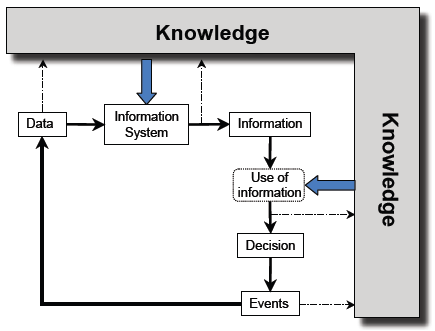
Data represents raw numbers and assertions. It comprises facts, observations or perceptions. Data is just bits, many zeroes and ones.

Example: Bits representing score on examination including score in test 1 and score in test 2.

Information is data with context and relevance. While data are nothing but useless garbage bits and uninterpretable zeroes and ones, information can be used to obtain a more meaningful indication of trends and patterns.

Example: In a test, the result of the frequency of errors interprets if the item is too difficult or too easy to answer.

Knowledge is information with decision-making and action-directed utility and purpose. Knowledge is the highest level in the hierarchy, with information in them middle, and data ot be at the lowest level. This is the richest, deepest and most valuable of the three.

Example: The information in the frequency error and score of test items shows the validity of each item in the test if there's a need to be retained or to be revised.

Knowledge is the information that helps to produce information from data or produce valuable information from less valuable information.


Types of Knowledge

Epistemology is the branch of philosophy that studies the nature of knowledge, its presuppositions and foundations, and its extent and validity (American Heritage Dictionary of the English Language, Fourth Edition.

There are many classifications and characterizations of types of knowledge, e.g. individual, social, causal, conditional, relational, pragmatic encoded, encoded and procedural. It is very important to know what knowledge is before we can manage it effectively.

Subjective View of Knowledge

In this kind of view, reality is entirely dependent on human perception and is socially constructed through interaction and individuals.  
·         Knowledge has no existence independently of social practices and human experience
·         Knowledge is not an independent object
·         Knowledge has no single location
·         Knowledge is viewed as an on-going accomplishment

Objective View of Knowledge

In objective view of knowledge, reality is independent of human perceptions and can be structured in terms of priori categories and concepts. 
·         Knowledge can be located
·         Knowledge is something that can be stored, transferred, and manipulated
·         Knowledge enables access and utilization of information
·         Knowledge is a strategic capability that can potentially be applied to seek a competitive
      
advantage 

Procedural vs. Declarative Knowledge

Declarative Knowledge focuses on beliefs about relationships among variables.

Example: “All other things being equal, greater price charge for a product would cause some reduction in its number of sales.”

It can be stated in the form of logical propositions, expected correlations, or formulas relating concepts represented as logical symbols and/or mathematical variables. This is often characterized in KM circles as “know-what.”

Procedural Knowledge focuses on beliefs relating procedures or processes: sequences or steps or actions to desired or undesired outcomes.  

Example: The procedure that should be followed in a government organization in deciding on whom to award the contract for a particular area (information system development).
It is often characterized in KM circles as “know-how.”

Tacit vs. Explicit

Tacit Knowledge includes insights, intuitions, and hunches that are not verbalized or documented. This is usually difficult to express and formalized. Therefore, it is difficult to share. It is a phenomenon wherein the employee can’t really tell how to do something.  

Explicit Knowledge refers to knowledge that has been expressed into words or numbers. It can be shared formally and systematically in the form of data, specifications, manuals, drawings, audio or video tapes, computer programs, patents, etc.

Can we convert explicit knowledge to tacit knowledge?

We often convert explicit knowledge to tacit knowledge. It usually happens when an individual reads a book and learns some insights from it, but not by rote memorization.  

Can we convert tacit knowledge to explicit knowledge?

We can sometimes convert tacit knowledge to explicit knowledge. It happens when an individual, who has a lot of tacit knowledge, writes a book formalizing that knowledge. More often, it is like difficult conversion that requires hard efforts.

General vs. Specific Knowledge

General Knowledge is possessed by a large number of individuals and can be transferred easily across individuals.

Example: Headache is one symptom of brain hemorrhage.

Specific Knowledge (idiosyncratic knowledge) is possessed by a very limited number of individuals, and is expensive to transfer.

Example: How to operate on a patient suffering a stroke.

Technically vs. Contextually Specific Knowledge

Technically Specific Knowledge is a deep knowledge about a specific area. It includes tools and techniques for solving problems. It is often acquired through formal training and experience in the field.

Examples:          
  • The scientific knowledge of a marine biologist
  • The knowledge about computer hardware by an engineer
Contextually Specific Knowledge refers to the knowledge of particular circumstances of time and place in which work is to be performed. It can not be acquired through formal training.

Examples:               
  • The detailed knowledge that design engineers possessed about the idiosyncrasies of the particular design group they are working 
  • Basketball forward detailed knowledge about the team’s center
Reference:
Becerra-Fernandez, I. and Sabherwal, R. (2010). Knowledge Management: Systems and Processes. New York: ME Sharpe, Inc.